
Kabaddi: From the Village Pit to the Global Stage
प्रश्न: कबड्डी क्या है? उत्तर: कबड्डी सात-सात खिलाड़ियों की दो टीमों का संपर्क खेल है, जिसमें एक रेडर तीस सेकंड के भीतर विपक्षी अर्धभाग में जाकर रक्षकों को छूकर लौटता है। प्रश्न: कबड्डी एशियाई खेलों में कब शामिल हुई? उत्तर: पुरुष वर्ग में 1990 के बीजिंग एशियाई खेलों में और महिला वर्ग में 2010 के ग्वांगझोउ एशियाई खेलों में। प्रश्न: डू-ऑर-डाई रेड क्या है? उत्तर: लगातार दो बार बिना अंक लौटे रेडर को तीसरे प्रयास में अंक लेना अनिवार्य होता है, अन्यथा वह बाहर हो जाता है। प्रश्न: पेशेवर कबड्डी लीग कब शुरू हुई? उत्तर: 2014 में फ्रेंचाइजी आधारित घरेलू लीग के रूप में। प्रश्न: कबड्डी मैदान का आकार क्या है? उत्तर: पुरुषों के लिए 13 x 10 मीटर और महिलाओं के लिए 12 x 8 मीटर। प्रश्न: क्या कबड्डी ओलंपिक खेल है? उत्तर: नहीं, कबड्डी अभी ओलंपिक कार्यक्रम का हिस्सा नहीं है; वैश्विक भागीदारी और प्रसारण बाजार इसकी मुख्य बाधाएं हैं।
For a long time, kabaddi carried a fixed image: a village game, played on a dusty patch, where two groups face off in the evening and by the next morning nobody remembers who won. That image has broken. Over the past decade kabaddi has become not just a television product but a professional ecosystem, complete with contracts, player auctions, physiotherapists, nutritionists, video analysts and brand managers.
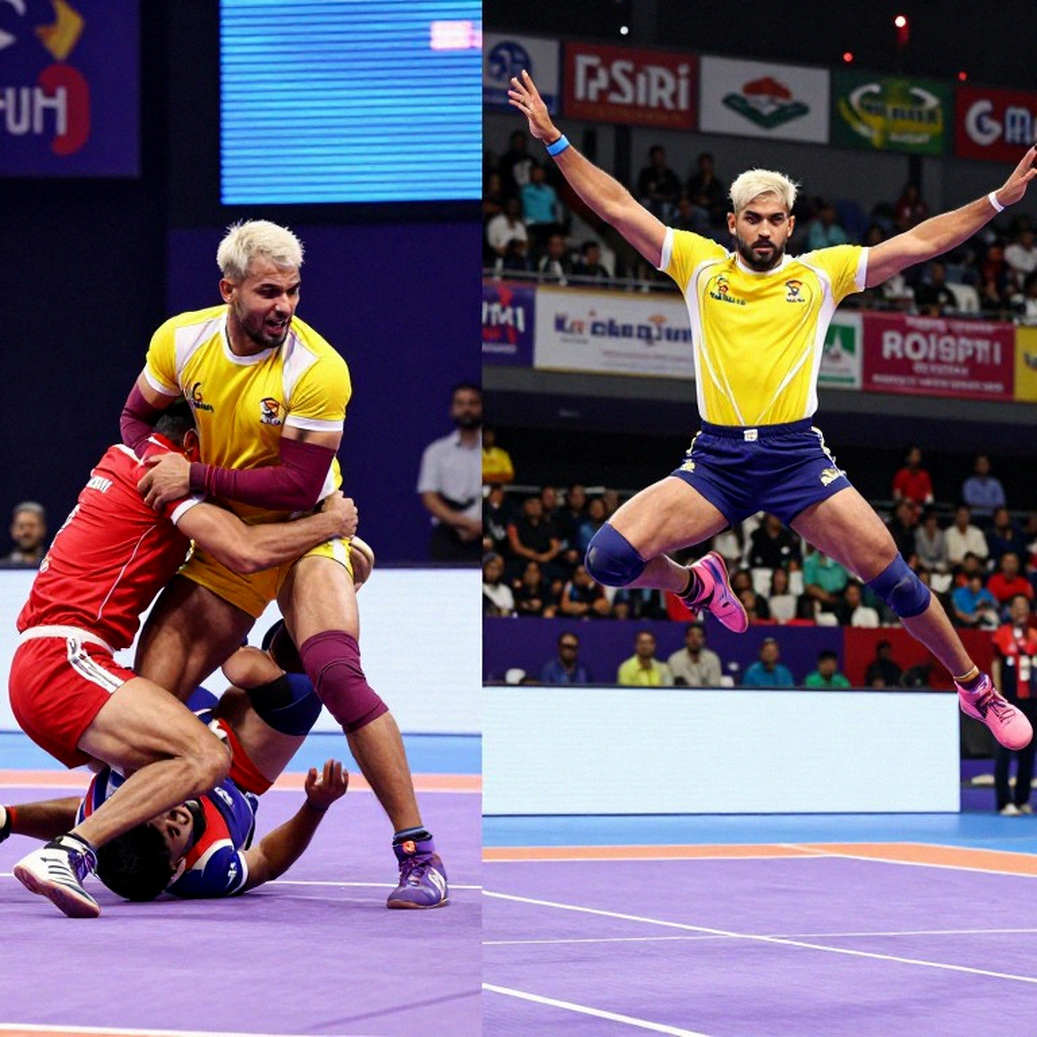
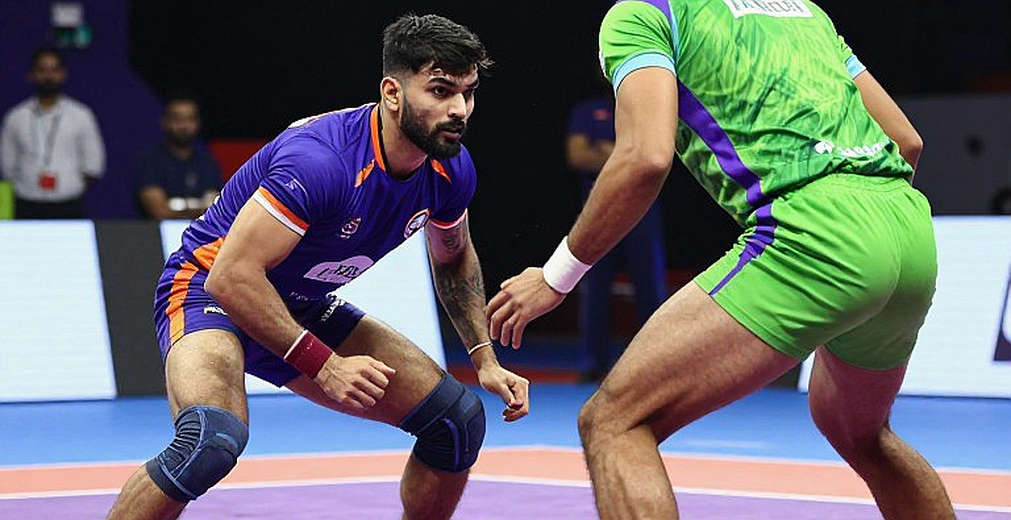
The core structure of the sport is simple, and that simplicity is its greatest strength. Two teams of seven players alternate between raiding and defending. A single attacker, the raider, crosses into the opposition half, touches one or more defenders and returns to his own half. The whole action must be completed within thirty seconds. Each touch earns the raiding team a point.
The defending side is not passive. If the defenders catch the raider and prevent him from returning to his half, the defending team earns a point and the raider is out. That is the moment that makes kabaddi gripping: one person against seven, where every fraction of a second is decisive.
The most dramatic rule is the do-or-die raid. If a raider returns empty-handed twice in succession, the third attempt must yield a point or the raider is eliminated. This rule changed strategy. Teams can no longer rely purely on safe play; they must take risk, and that risk produces genuine theatre.
The dimensions of the mat are clearly defined. For men, the court is thirteen by ten metres; for women, twelve by eight. The midline, baulk line and bonus line together define the geography of strategy. For a raider, the lure of a bonus point and the need to escape operate simultaneously.
The simplicity of these rules is deceptive. Kabaddi is physically among the hardest contact sports. It demands explosive speed, rapid changes of direction, a strong core, flexibility and instant decision-making. A raider must negotiate three to four metres of space inside a ring of seven defenders, while still remembering the route back the other way.
The professional turn came in 2026, when a franchise-based domestic league launched. It gave the sport not only a broadcast package but a market for players that had not previously existed. The auction process made player value public, and that publicity changed the economic standing of the sport itself.
Before this, a kabaddi player's identity was often tied to a government job — a posting in the railways, police, customs or a public undertaking served as the social security net attached to the sport. Professional contracts opened an alternative route, in which a player's earnings were linked directly to performance and market position.
The change is not only financial. Teams have increased investment in support staff. Recovery protocols, injury management, load management and travel management are now part of professional structure. Video analysis has become standard. A rival raider's preferred moves and a rival defence's weak chain are identified through data.
But the professional economy also brings inequality. Resources concentrate in a handful of franchises and a handful of geographic centres. In states without league representation, the stage for talent remains limited. The talent identification process is still largely informal.
Geographically, the most significant development is Iran's rise. Iran has registered a strong presence both at national team level and in the professional league. Its strength did not appear suddenly — the country has a deep wrestling tradition, which nurtured physical preparation and a contact-sport mentality. Iranian defence is known for its technique and discipline.
In Bangladesh, kabaddi enjoys the status of national sport, with a very large grassroots base. This is an important point: kabaddi's global expansion is not following the pattern of cricket or football, where colonial structures and large markets set the direction. Here expansion runs through cultural proximity and diaspora communities.
Within South Asia, Sri Lanka, Nepal and India's north-eastern states have a long history of the game. In Southeast Asia, Thailand, Malaysia and Indonesia have increased their participation in international competitions. In East Asia, Japan and South Korea are less visible, but a steady base is being built through corporate teams and university-level programmes.
In Europe and Africa, kabaddi is still experimental. Some countries have club-level activity, others have national federations. This phase is necessary, because the measure of a sport's globality is not viewer numbers alone but the continuity of organised competition across continents.
Within the Asian Games, kabaddi's trajectory is clear. At the 2026 Beijing Asian Games it was granted official sport status in the men's category. Two decades later, at the 2026 Guangzhou Asian Games, women's kabaddi also received official status. These two steps came at different times, and that gap exposed the structure of gender inequality inside the sport.
Securing a place at the Olympics is kabaddi's biggest unfinished goal. The obstacles are real: the global distribution of participating countries is limited, the structure of the broadcast market is concentrated in a few regions, and the Olympic movement has its own priorities. Entry is not granted on popularity alone; organisational stability, doping control, a judicial framework and continuity of a global calendar are all required.
The state of women's kabaddi is the most sensitive part of this discussion. Participation has grown, competitions have grown, and professional opportunities for women players exist domestically in a limited form. But social resistance remains intense in many regions — many girls must fight continuously at family and community level to keep playing.
The supply chain of talent still runs mainly through the ground. School and university competitions, block and district level events, and a few institutional sports academies are the main components. Many players move from village fair tournaments to state teams and then to the league. That path is inspiring, but it also depends heavily on chance.
The burden of injury is the least discussed aspect of the sport. Shoulders, knees and ankles are repeatedly affected by contact and falls in unnatural directions. When the calendar is dense, recovery time shrinks and injury risk rises. The real test of a professional structure is how many years it lets a player keep playing.
Technology's presence is growing, but it should be viewed with caution. Video review improves the accuracy of decisions, but it can also break the flow of the game. Wearables that measure player activity are useful in injury management, but their use raises questions of player consent and data ownership.
At the governance level, kabaddi faces a dual challenge. The division of authority between national federations, continental bodies and the international organisation is not always clear. And where the economic power of a private league grows, tension over control of the sport is natural. Organised player representation remains weak.
Integrity is another issue. As soon as a betting market forms around a sport, the risk of match-fixing forms with it. Monitoring systems, transparent contracts and independent complaint procedures are not merely matters of good conduct; they are matters of protecting capital investment.
From a media perspective, the biggest change is that commentary is no longer only in English. Broadcasting and commentary in regional languages have widened the audience base geographically. Kabaddi's strength is precisely that you do not need to read a long rulebook to understand it.
The road ahead depends on three things. First, expanding grassroots structure — continuous competition at school and club level. Second, expanding investment in the women's game, where capacity is large and opportunity is small. Third, building more than one economic pillar, so the sport does not depend on the broadcast cycle of a single league.
The risks are equally clear. Dependence on a single league, volatility in broadcast revenue, talent drifting to other sports, and administrative disputes. This is a normal crisis for any emerging sport, but kabaddi's case is different because its global base is still thin.
Kabaddi's story is an example of how a sport's globalisation is not a linear process. It is the convergence of three forces: rules, capital and community. The rules are clear, the capital has arrived, and the community was already there. The real question is how long these three will sustain one another.
A sport stays alive as long as people keep stepping onto the field, not as long as it keeps being broadcast. Kabaddi has the inheritance that both football and cricket have — it came out of the soil. The question is whether it can stay connected to the soil that gave birth to it.
संबंधित खिलाड़ी
अनुशंसित
Kabaddi: From the Mud Akhara to Broadcast Graphics2026-11-03
India vs Uganda: At the Commonwealth Kabaddi Championship 2026, the Real Question Isn't the Match — It's the Field2026-10-25
Kabaddi: From the Mud Akhara to the Broadcast Studio2026-11-01
Kabaddi: From Mud Courts to Global Leagues, the Changing Face of a Sport2026-11-02
India vs Uganda, Commonwealth Kabaddi Championship 2026: The Defensive Crack Hidden Inside a 46-26 Win2026-10-26
Ahmedabad's First Evening: Where the Points Table Ranked Teams That Had Not Yet Stepped on the Mat2026-10-28
The Kabaddi Auction Is Not a Transfer Window — It Is Price Discovery for a Labour Market Still Paid in Railway Jobs2026-10-24
अनुशंसित
Kabaddi: From the Village Pit to the Global Stage2026-11-02
Commonwealth Kabaddi Championship: 13 Nations, 62 Matches, and India's Real Test Is Six Days Long2026-10-24
Precision or Cult: The 138-Row Spreadsheet of Indian Kabaddi Coverage, and the 139th Row Nobody Invited2026-11-03
India vs Uganda, Commonwealth Kabaddi Championship 2026: The Defensive Crack Hidden Inside a 46-26 Win2026-10-26
India vs Uganda, Match 9 Preview: The 26 Points Hidden Inside a 20-Point Win2026-10-25
Empty Analysis, Empty Stands: Kabaddi’s Real Problem Is Data Emptiness2026-10-26
India vs Uganda: At the Commonwealth Kabaddi Championship 2026, the Real Question Isn't the Match — It's the Field2026-10-25