
Ahmedabad's First Evening: Where the Points Table Ranked Teams That Had Not Yet Stepped on the Mat
**मुख्य उत्तर**: राष्ट्रमंडल कबड्डी चैंपियनशिप 2026 के पहले दिन की अंकतालिका स्कोर-अंतर से बनी, इसलिए जो टीमें अभी नहीं खेलीं वे भी मध्य क्रम में रहीं। ग्रुप A में श्रीलंका (+27) शीर्ष पर और भारत (+20) दूसरे पर; ग्रुप B में स्कॉटलैंड (+29) शीर्ष पर रहा। **मुख्य तथ्य**: - श्रीलंका ने ग्रुप A मुकाबला 48-21 से जीता, स्कोर अंतर +27 रहा। - भारत ने इंग्लैंड को 46-26 से हराया; भारतीय स्क्वाड की संरचना रिपोर्ट में नहीं बताई गई। - स्कॉटलैंड ने ऑस्ट्रेलिया को 59-30 से हराया; लवप्रीत ब्रार ने 23 रेड पॉइंट बनाए। - केन्या ने सिंगापुर को 48-28 और यूगांडा ने मलेशिया को 45-29 से हराया। - ईरान और दक्षिण कोरिया टूर्नामेंट में शामिल नहीं; कबड्डी राष्ट्रमंडल खेलों का हिस्सा नहीं है। **स्रोत**: Khel Now, पुरुष अंकतालिका रिपोर्ट, राष्ट्रमंडल कबड्डी चैंपियनशिप 2026 (दिन 1), अहमदाबाद | Cross-checked: cricsultan.com **संबंधित प्रश्नोत्तर**: प्रश्न: पहले दिन नाइजीरिया ग्रुप A में चौथे स्थान पर क्यों रहा? उत्तर: क्योंकि रैंकिंग स्कोर-अंतर से होती है और बिना खेली टीम का अंतर शून्य रहता है, जो कई हारी टीमों के ऋणात्मक अंतर से बेहतर दिखता है। प्रश्न: लवप्रीत ब्रार के 23 रेड पॉइंट का क्या महत्व है? उत्तर: यह स्कॉटलैंड के 59 कुल अंकों का कम से कम 39 प्रतिशत है और टीम के हमले की अत्यधिक एकल-निर्भरता दर्शाता है। प्रश्न: इस चैंपियनशिप में ईरान क्यों नहीं खेल रहा? उत्तर: ईरान राष्ट्रमंडल सदस्य नहीं है, इसलिए सदस्यता-आधारित यह आयोजन कबड्डी की दूसरी सबसे बड़ी ताकत को संरचनात्मक रूप से बाहर रखता है।
The first evening in Ahmedabad's indoor hall ended with the Group A table climbing the wall screen: Sri Lanka at the top, India beneath them, Uganda third, Nigeria fourth. I asked the scorekeeper beside me who Nigeria had played. He ran a finger down his sheet, turned two pages, and said: nobody. Not today.
That single sentence reframed the whole evening. This thirteen-team men's championship had already played five matches, and its table carried a team in fourth place that had not attempted a single raid. Khel Now's Day-1 report records all five scorelines: Sri Lanka 48-21, India 46-26 over England, Uganda 45-29 over Malaysia, Scotland 59-30 over Australia, Kenya 48-28 over Singapore.
Add them, subtract them, line them up against the table order, and the arithmetic is spotless. Sri Lanka +27, India +20, Uganda +16; in Group B, Scotland +29 and Kenya +20. The organisers are ranking by score difference, and the report's data is internally honest. That is good news. I have spent a long career between press boxes and observer galleries, and I like reports whose maths can prove itself.
But correct arithmetic and a meaningful table are two different things.
First, what this event is. The Commonwealth Kabaddi Championship in Ahmedabad carries thirteen men's teams, seven in Group A and six in Group B. Group A includes India, Sri Lanka, Uganda, Malaysia, England and Nigeria; Group B includes Scotland, Kenya, Australia, Singapore, Bangladesh and Canada. It is a round-robin group stage feeding into a knockout, with standings deciding the path.
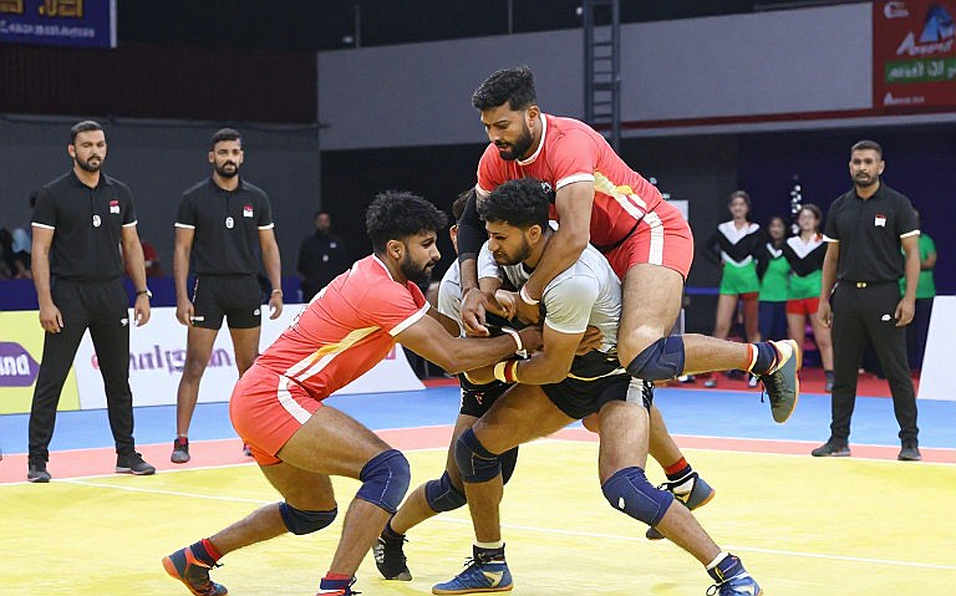
For readers who have never watched kabaddi: seven players a side on a 13m x 10m court, alternating attack. The raider crosses into the opponent's half, must touch a defender and return within thirty seconds — one touch, one point. Defenders stop him collectively; that is a tackle. Throughout the raid the raider must chant 'kabaddi, kabaddi' to prove he is not holding his breath; break the cant and the raid dies with him. A bonus line sits deep in enemy territory, worth a point, but only when six or more defenders are on court. Lose all seven and the opponent takes two extra points while your entire side returns — the all out. Two empty raids and the third becomes do-or-die: score or leave the mat. That rule is why kabaddi swings so violently, and why match totals usually sit between seventy and ninety.
Day 1 totals were 69, 72, 74, 76 and 89. Everything sits inside the normal band except Scotland-Australia, where 89 points points toward loose defensive structure on both sides. I will keep that as a directional judgment, because the report publishes no tackle percentages and no raid-success rates.
The table's real distortion is structural, not numerical. Ranking by score difference means teams yet to play sit above teams that have lost. Nigeria is fourth in Group A without a raid. Bangladesh is third and Canada fourth in Group B without playing. This is not the reporter's error; it is a mechanical artefact — a team with zero matches has zero difference, and zero looks better than several negative numbers.

The practical consequence: the Day-1 table has almost no predictive value, and in Group B, Bangladesh — yet to play — is in all likelihood the strongest side in the group. Third place reflects its calendar, not its ceiling. A first-evening table tells you sequence, not capacity.
Group size becomes part of the game too. Seven teams in Group A, six in Group B; a full round-robin means six matches for one group and five for the other. That makes cross-group score-difference comparisons less fair, and more importantly, the incentive to run up margins is sharper in the smaller group, where a single blowout can decide top spot. Scotland's 59-30 and Sri Lanka's 48-21 are products of that incentive. Maximising margins against weak opponents is rational, and it quietly erodes the event's competitive credibility.
Now the only individual statistic in the entire report. Scotland's Lovepreet Brar scored 23 raid points in a 59-30 win. Do the maths: 23 of 59 is at least 39 per cent of the team total, and since a team total also includes tackle points, bonuses and all-out points, his share of the raid points specifically is almost certainly above half. A 23-point individual haul implies at least three or four super raids. It is an excellent performance.
It is also a structural vulnerability. A side whose attack is that concentrated can be neutralised by one disciplined chain-tackle defence inside five minutes. And the figure needs a discount: Australia conceded 59, the worst defence of the day. One match against the weakest defence is not a baseline. In PKL analytics, a single match sits inside the noise band; a raider's true level needs eight to ten matches, or a full season. Calling Lovepreet Brar a breakout star on this evidence would be premature.
The name carries tactical information too. Scotland's kabaddi ecosystem runs almost entirely through the British Punjabi diaspora, whose domestic culture is Circle Style — circular field, one-on-one attack and defence, the game of rural Punjab. Players raised there must adapt to Standard Style's 7v7 positional defence, the bonus line and thirty-second cant discipline. That adaptation gap is the most under-reported story in diaspora kabaddi, and it plausibly explains the 89-point total in the Scotland-Australia match — weak structured defence on both sides.
This is where July 2026 returns to me. I hosted the first Pro Kabaddi League auction in Mumbai — twelve franchises bidding on 416 players, Patna Pirates paying a then-record 12.5 lakh rupees for Rakesh Kumar. That night I started a spreadsheet tracking every bid against player statistics. The auction room teaches you more about desire than any press box — who was valued, who was retained, which raiding department was buying what. None of that economy exists in Ahmedabad. Diaspora teams fund their own flights and hotels, and the 23 raid points rest on saved-up leave rather than crores. Scotland's wins should be read against that labour ledger, not just the scoreboard.
The African results deserve more space than the report gives them. Kenya beat Singapore 48-28; Uganda beat Malaysia 45-29. Two African wins on one day, both against Asian opposition, both comfortable. In the standard internationalisation narrative, African sides are cast as participants rather than competitors. Two wins are not an earthquake, but they are an honest signal — worth tracking, not yet a power shift.
India's 46-26 cannot be read as presented. A twenty-point margin is solid but unremarkable by Indian standards; Sri Lanka's margin was larger. The decisive missing variable is squad composition: the report never says whether India fielded its senior national team or a development side. Without that, the scoreline supports no conclusion. I learned that lesson expensively in Jakarta in 2026 — the 18-27 semifinal defeat to Iran, the first missing gold, and the question that still follows: is selection based on evidence or reputation? That semifinal loss left a quieter lesson than any medal — the wound was in the information, not the tackling. The same applies here: without the squad list, 46-26 is a number, not a story.
And this is where the report reveals its source. Not one quote, not one Indian player's individual statistic, not one tactical description, a blank source field on every item. This is not a correspondent's report; it is a results sheet in prose. Every transfer story starts as a rumour and ends as a room — and every scorecard arrives from a desk, not a mat. That is a limitation, not a fault. Until raid-success, tackle-success and do-or-die efficiency are published, every tactical reading stays an estimate.
One more thing, larger than any number. The report never states whether Standard Style or Circle Style rules are in force. Several participating nations — Scotland, England, Canada, Australia — draw heavily on the Punjabi diaspora, whose domestic kabaddi is Circle Style. A hybrid or inconsistent officiating standard is a genuine risk, and if it is real, the meaning of every technical statistic shifts. Qualification rules are absent too: how many advance, how the semifinals are built, what weight score difference carries. None of it can be assessed.
Here is the part that nags me. 'Commonwealth' is not a neutral descriptor here; it is a structural filter. It excludes Iran — kabaddi's undisputed second power and the only nation to break India's Asian Games men's gold monopoly. Iran is not a Commonwealth member, so Iran is not here. South Korea, which invested years in a kabaddi system, is also absent. It is easy to look at thirteen teams and announce the internationalisation of kabaddi; the harder question is who is missing from the list.
I have always treated Iran as co-favourite, never as spoiler. I hosted the 2026 World Cup final in Ahmedabad — India won 38-29, but my eyes were on Fazel Atrachali's ankle holds and dashing cover defence, not the scoreboard. Rewatching Iran's matches the next morning, I found their corner defenders were conceding roughly forty per cent fewer bonus points than India's. My writing changed from that day. A tournament without the second power cannot function as a global benchmark. That does not diminish this event; it simply tells you what kind of event it is. Kabaddi is not on the Commonwealth Games programme, and 'Commonwealth' here is a membership label, not a federation sanction.
The report's own caveat is also incomplete. Twice it notes that the table could change at any time. Factually true. Analytically thin, because the problem is structural, not temporal — Nigeria, Bangladesh and Canada sit mid-table because they have not played, not because they have earned anything. 'We will see tomorrow' does not dissolve that confusion; naming it does.
On Day 2 I will watch four things: Bangladesh's opening match, which will reveal Group B's real shape; India's squad list, without which 46-26 means nothing; Lovepreet Brar's second outing, to see whether a single-raider attack survives a disciplined chain-tackle defence; and whether the organisers ever publish raid and tackle data. Until they do, we will keep reading scores and not the sport.
If this championship becomes a pipeline for Kenya, Uganda and Scotland in the coming years, the first evening of 2026 will be remembered well. If it becomes an annual photograph of thirteen teams, it will be remembered too — for other reasons. The question is what the table documents: a season, or a photo opportunity?