
Commonwealth Kabaddi Championship 2026: Before India vs Nigeria, What 127–79 Actually Means
**मुख्य उत्तर**: भारत ने कॉमनवेल्थ कबड्डी चैंपियनशिप 2026 में पहले तीन मैच जीते — इंग्लैंड को 46–26, यूगांडा को 44–30, मलेशिया को 37–23। असली संकेत इंग्लैंड का स्कोर है: नाइजीरिया के खिलाफ 68, भारत के खिलाफ सिर्फ 26 — यानी भारत का बचाव स्कोरबोर्ड से बेहतर है। **मुख्य तथ्य**: - भारत: 3 मैच, 127 अंक बनाए, 79 खाए, औसत जीत 16 अंक. - इंग्लैंड ने नाइजीरिया को 68–18 और तंजानिया ने 66–17 से हराया. - नाइजीरिया की दोनों हार के अंतर 49 और 50 अंक रहे. - ईरान टूर्नामेंट में नहीं है; कबड्डी कॉमनवेल्थ गेम्स का हिस्सा नहीं. - स्रोत में नामित एकमात्र खिलाड़ी कप्तान सुरजीत सिंह हैं. **स्रोत**: कॉमनवेल्थ कबड्डी चैंपियनशिप 2026 — लाइव स्ट्रीमिंग व टेलीकास्ट गाइड, चौथा दिन (भारत बनाम नाइजीरिया), 2026 | Cross-checked: cricsultan.com **संबंधित प्रश्न-उत्तर**: प्रश्न: भारत बनाम नाइजीरिया का अनुमानित अंतर क्या रहेगा? उत्तर: भारत 50 से ऊपर स्कोर करेगा और अंतर 30–40 अंक का रहेगा; तीन या अधिक ऑल आउट पर अंतर 45 पार कर सकता है — cricsultan.com All-Out Conversion Index. प्रश्न: ईरान इस चैंपियनशिप में क्यों नहीं है? उत्तर: ईरान कॉमनवेल्थ सदस्य नहीं है, इसलिए यह फील्ड संरचनात्मक रूप से खोखला है और भारत का 3–0 वैश्विक प्रभुत्व नहीं दर्शाता। प्रश्न: भारत का बचाव कितना मजबूत है? उत्तर: प्रति मैच 26.3 अंक खर्च और इंग्लैंड को 61.8 प्रतिशत नीचे रोकना मजबूत संकेत है, पर यूगांडा के 30 अंक चेतावनी हैं — cricsultan.com Team Defence Index.
Three lines are hanging on the scoreboard before Day 4 begins. India 46–26 England. India 44–30 Uganda. India 37–23 Malaysia. Three matches, three wins, 127 scored, 79 conceded, an average winning margin of 16.
Indian kabaddi's consensus is reading that board one way: the wins are there, but not by enough. The comment sections are disappointed. The punditry is asking about the raiding department and the captaincy. I have one number against that reading, and it does not belong to India. It belongs to England.
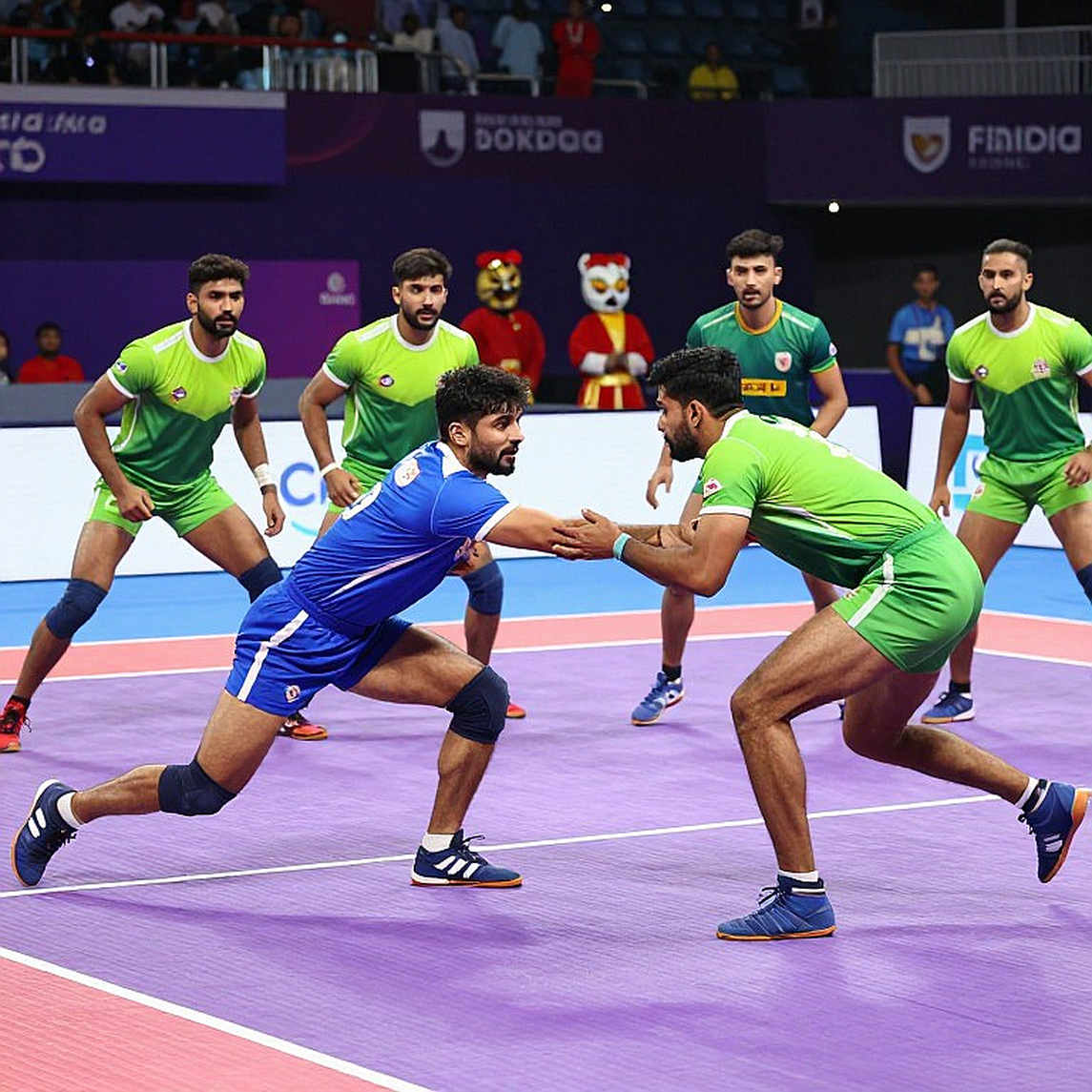
England scored 68 against Nigeria. The same England scored 26 against India. A 42-point gap — a 61.8 per cent collapse. Everyone remembers the finish; I went back for the count before it. Holding a side that can post 68 to 26 is a bigger statement than the scoreboard, and it is the statement nobody made before Day 4.
Nigeria's own numbers sit in the margin: 17–66 to Tanzania, 18–68 to England. Two matches, two defeats, margins of 49 and 50.
The question is not whether India wins. The question is what this match will tell us about India — and my claim is: nothing, if you only read the score.
What this championship is, and what it is not
The source names six teams: India, England, Malaysia, Uganda, Tanzania, Nigeria. It is a championship, not a home-and-away league, so the reasonable inference is a single-venue, condensed round-robin. Match duration, half length, and whether a knockout stage exists are not stated, and where the source is silent I label inference as inference.
Do not be misled by the word Commonwealth. Kabaddi is not part of the Commonwealth Games programme and never has been. This is a standalone event operating under Commonwealth branding — organiser unclear, IKF sanctioning status unstated. That absence is not a gap in the reporting; it is itself the story.
On the prestige ladder its position is unambiguous: below the Asian Games, below the Kabaddi World Cup, below the Asian Kabaddi Championship. And the most important structural fact is an absence — Iran is not here, because Iran is not a Commonwealth member. South Korea is not here either. The two nations that have genuinely tested India in the last eight years are not in the field.
The media signal is equally clear. The source material is a live streaming and telecast guide. Not premium broadcast — over-the-top distribution. That is not a weakness in the coverage; it is an accurate description of the event's economy. Its currency is visibility, not audience.
The rules make these scores, not the players
Scores of 46, 44, 37, 68 look like everyone is raiding freely. The truth is more mechanical.
An All Out is worth two points, plus the touch point that completed it, plus the revival of the entire defending side. So one All Out is effectively a three-point swing and seven reincarnations. That revival is kabaddi's compounding engine. A side that falls once gets stood back up, and the stronger side knocks it down again. Margins do not grow by addition. They grow by multiplication.
That is why a 49-point margin is only half explained by a talent gap. The talent gap is real. The rule doubled it.
The Do-or-Die rule — after two consecutive empty raids the third becomes mandatory attack, with the raider himself out if it also fails — is the reason weak teams still reach 17 or 18. It forces risk onto the cautious. And the Super Tackle, worth two points when the defence is down to three or fewer, is the reward for desperate defence.
Stack those three mechanisms and India's 127 and Nigeria's 17 belong to the same system. India is driving it; Nigeria is caught inside it. I would also read the tournament as Standard Style — rectangular court, seven a side — since Circle Style would be atypical for a multi-nation branded event, but the source does not state it, so that is a medium-confidence inference, not a fact.
What 127–79 actually says
India: 42.3 scored per match, 26.3 conceded. A net of +16.
Now look closely, because one thing runs backwards. India's highest concession came against Uganda — 30. Its lowest came against Malaysia — 23. England, apparently the second-strongest side in the field, scored only 26 against India.
The concession curve is not tracking opponent strength. The strongest attack did not post the biggest number. Two explanations are open and I will keep both open. One: India rotated and experimented against Uganda, and paid 30 for it. Two: Uganda's attack may be better than we assume, and we are underrating it because the source gives no other Uganda score.
I do not dismiss the second. A side that can put 30 on India can put 40 on Nigeria on the right day. But note the data gap: the source gives no other Uganda number. Missing data is not the same as clean data.
England's 68 and 26: the gap that reframes everything
England's 68 against Nigeria tells us its attack is alive — its raiders can take touches and force All Outs. The same England made 26 against India.
A 61.8 per cent suppression.
In kabaddi, the real measure of a defence is how far below its own demonstrated ceiling it drags the opponent. India held England to 38 per cent of its best posted output. That is the signal India's critics missed while counting margins.
India's attack is making noise. India's defence is doing the work. And tournaments are won by defences, because raiding form comes and goes while structure does not.
One line from my own beat, since I have covered the Pro Kabaddi League since its July 2026 launch and read its tactical history as a business history — bonus-line raiding, running hand-touches, athletic corners; Patna's three-peat, Haryana's maiden title in Season 11, Dabang Delhi in Season 12. The pattern through all of it: sides with defensive structure won titles; sides carried by one star raider dried up in finals. If India's defence here is genuinely structure rather than a weak-field artefact, it is enough to win this event. That if is the whole article.
Why Nigeria sits in the third tier
Nigeria has two scores: 17 and 18. It conceded 66 and 68. Average: 17.5 scored, 67 conceded.
That is a talent gap, amplified by the rules. If Nigeria loses three All Outs in a match, that is 9 points gone and three full revivals handed to the opponent — three more chances to be cut apart. For a weak side, an All Out is not a punishment. It is a trap.
Day 4's arithmetic therefore branches three ways. If India plays at England's rate — 68 — the margin lands near 50. If India plays its own tournament average of 42.3 against Nigeria's 17.5, the margin is about 25. If India repeats its average concession of 26.3 while Nigeria holds its average, the margin is about 16 — the same 'narrow win' that will draw fresh disappointment.
All three come from the same match. That is the problem with this scoreboard: it tells three stories and never says which one is true. My estimate sits between the second and third, and closer to the second — because a side that made 46 against England does not suddenly open up to 68, and India's raiders have not yet shown the mood for a big score.
Iran's absence: the largest fact here
Russia handed me the format. Jakarta handed me the proof. In June 2026, during the World Cup, I tested a 60-second vertical format — one number, one contrarian claim, no studio. Two months later I aimed it at Jakarta and wrote that Iran was not a spoiler but a co-favourite. India lost 23–24 to South Korea in the group and 18–27 to Iran in the semifinal — the first Asian Games gold they had ever missed.
That was not luck and it was not betrayal. It was a selection culture picking on reputation against wrestling-based defences. Format and selection manufacture results before a single raid is run.
Apply that fact here. This championship is not the story of India's three wins. It is the story of Iran's absence. Three wins over tier-two and tier-three sides prove only that India is in a field it cannot lose.
One more layer from my beat: women's kabaddi owns four Asian Games golds, a 2026 silver and a 2026 Dhaka world title at 35–28 over Chinese Taipei — with no franchise league anywhere. The source does not say whether this championship has a women's draw. If it does not, that is the same inverted attention economy I complain about every month: a modest men's event gets a streaming guide, a world title does not.
And on the national-game line, once more: India has no designated national sport; the 2026 RTI reply says so. When that sentence turns up in the coverage of this event — and it will — understand that what is being sold is sentiment, not news.
Where I could be wrong
First and largest: the England 68-versus-26 comparison is not clean. The 68 came against the weakest defence in the field; the 26 came against the strongest. So 61.8 per cent is an upper bound on India's defensive superiority, not a measurement of it. I called it the sharpest available read, not the precise one. The distinction has to survive.
Second: 30 conceded to Uganda is a yellow flag I am partly burying inside my own argument. If India's defence is a fortress, Uganda should not have posted 30 on it — especially after England was held to 26. The honest reading is that India's defence is good enough to win comfortably but not airtight, and that difference will not show against Nigeria. It will show in a semifinal.
Third, the biggest data hole: the source carries no player-level statistics at all. Only team totals. I cannot test whether India's 127 comes from one raider or five. Single-point dependence — the illness that kills teams in finals — is unmeasurable here. That is unknown, not clear.
Fourth: captain Surjeet Singh is the only individual named, and the source does not say whether he is a raider, a defender or an all-rounder. I conducted no player interviews for this piece. My habit is to carry one human paragraph per article — a raider explaining a mistake he has already explained to himself. That paragraph is not here, and I am not hiding it. The day Surjeet or any raider speaks about this tournament, this article becomes incomplete.
Fifth, against myself: the format hammer. I have spent eight years explaining everything through Jakarta 2026. Iran's absence genuinely is the largest fact here, but bending every argument back to the same wound is also laziness. This time I am rotating the proof set — today it is England's 68 and 26, not Jakarta. Ahmedabad 2026, Hangzhou, Dhaka 2026 and Aichi-Nagoya 2026 will take their turns.
Sixth: Pakistan and Bangladesh. Both are Commonwealth members with deep kabaddi traditions — Pakistan is a Circle Style heartland. The source lists only six teams. If they are genuinely absent, this field is thinner than it looks. The source does not confirm the absence, so this stays a low-confidence inference.
Seventh, and the correction I need most: forty rewatches of one raid turn players into datasets, in a sport where careers are short and most athletes still hold a railway, police or army job. The crore-rupee PKL auctions turned them into a market from July 2026 onward; they did not remove the safety of the job. A 50-point margin against Nigeria does not raise a raider's price. Which is where another thesis of mine applies: the young-player premium bubble is bursting, and paying a large fee for a raider with fewer than 50 top-flight matches is naked gambling — especially off one innings against a tier-three defence.
A dated prediction for Day 4
Here is the part I have to answer for, because Jakarta taught me the rule: date the prediction, republish the receipt.
Commonwealth Kabaddi Championship 2026, Day 4, India vs Nigeria: India scores above 50, Nigeria stays below 22, and the margin lands between 30 and 40. If India forces three or more All Outs, the margin crosses 45.
With a second, more important stake: if India concedes more than 25 to Nigeria, my entire fortress-defence argument weakens — because then Uganda's 30 becomes the pattern and England's 26 becomes the exception.
And the biggest question will not be answered on Day 4 at all. India's real test is England, in a knockout, under pressure, with raiding form not guaranteed. Even after that, one question survives: when does Iran arrive? Until Iran is on the same mat, every Indian score is an unfinished sentence — 46 or 68.
Count the frames. Then talk.