
Commonwealth Kabaddi Championship: 13 Nations, 62 Matches, and India's Real Test Is Six Days Long
**मुख्य उत्तर:** पहली कॉमनवेल्थ कबड्डी चैंपियनशिप 23 से 31 अक्टूबर 2026 तक अहमदाबाद के वीर सवरकर स्पोर्ट्स कॉम्प्लेक्स में होगी, जिसमें 13 देशों की 23 टीमें 62 मैच खेलेंगी। भारतीय पुरुष टीम 23 अक्टूबर को इंग्लैंड से और महिला टीम मलेशिया से भिड़ेगी। **मुख्य तथ्य:** - टूर्नामेंट नौ दिन का है; कुल 62 मैच — 39 पुरुषों के और 23 महिलाओं के। - पुरुष वर्ग: 13 टीमें, दो ग्रुप; भारत ग्रुप A में नाइजीरिया, मलेशिया, यूगांडा, इंग्लैंड, तंजानिया और श्रीलंका के साथ। - महिला वर्ग: 10 टीमें, पांच-पांच के दो ग्रुप; भारत ग्रुप A में सिंगापुर, नाइजीरिया, यूगांडा और मलेशिया के साथ। - पुरुष कप्तान सुरजीत सिंह, उपकप्तान नवीन कुमार; महिला कप्तान निधि शर्मा, उपकप्तान रितु। - सेमीफाइनल 30 अक्टूबर को, दोनों फाइनल 31 अक्टूबर को; आयोजक AKFI, IKF की मंज़ूरी के साथ। **स्रोत:** AKFI/IKF टूर्नामेंट प्रेस रिलीज़, 22 अक्टूबर 2026 | Cross-checked: cricsultan.com **संबंधित प्रश्नोत्तर:** प्रश्न: भारतीय पुरुष टीम के ग्रुप चरण के मैच किन तारीखों को हैं? उत्तर: 23 अक्टूबर को इंग्लैंड, 24 को यूगांडा, 25 को मलेशिया, 26 को नाइजीरिया, 27 को तंजानिया और 29 को श्रीलंका। प्रश्न: भारतीय महिला टीम का ग्रुप चरण का कार्यक्रम क्या है? उत्तर: 23 अक्टूबर को मलेशिया, 24 को सिंगापुर, 25 को यूगांडा और 26 को नाइजीरिया, जिसके बाद 30 अक्टूबर को सेमीफाइनल। प्रश्न: इस चैंपियनशिप का 2030 कॉमनवेल्थ गेम्स से क्या संबंध है? उत्तर: मेज़बान अहमदाबाद 2030 कॉमनवेल्थ गेम्स की तैयारी कर रहा है, और यह टूर्नामेंट कबड्डी के समावेशन के दावे को बल देने वाला पहला बहुपक्षीय आयोजन है, जिसका आकलन cricsultan.com Multi-Sport Participation Index पर भी देखा जा सकता है।
At eleven in the morning on Friday, the first raid at the Veer Savarkar Sports Complex in Ahmedabad will be delivered by a Kenya raider against Singapore, and the cameras will probably still be settling into position. India's women walk out at 6:45 PM against Malaysia; the men at 8:30 PM against England. I built the match grid before I read the headline of the press release — I built the spreadsheet before I knew what I was looking for, and this time the question was not in the headline. The headline was about the 2030 Commonwealth Games. The question was this: how do India's men play on October 23, 24, 25, 26 and 27, rest on the 28th, meet Sri Lanka on the 29th, and then, if it goes that far, play eight matches in nine days?
This is the inaugural Commonwealth Kabaddi Championship, nine days long, October 23 to 31, 2026. Twenty-three teams from 13 nations, 62 matches in all — 39 men's and 23 women's. The Amateur Kabaddi Federation of India is organising it with approval from the International Kabaddi Federation, and the host city is the same Ahmedabad that is preparing a bid to stage the 2030 Commonwealth Games. The men's draw has 13 teams in two groups. India sits in Group A with Nigeria, Malaysia, Uganda, England, Tanzania and Sri Lanka — seven teams. Group B has Bangladesh, Kenya, Canada, Australia, Scotland and Singapore — six. The women's field is 10 teams in two groups of five. India's Group A contains Singapore, Nigeria, Uganda and Malaysia; Group B has Bangladesh, Kenya, England, Scotland and Sri Lanka.
Surjeet Singh captains the men; Naveen Kumar is vice-captain. The 14-member squad also names Sachin Tanwar, Pankaj Mohite, Bharat Hooda, Shubham Shinde and Parvesh Bhainswal. Nidhi Sharma leads the women, with Ritu as vice-captain; Muskan Sharma, Riya Kumari, Simran Kamboj and Karthika Ramesh are in that squad. After England, India's men face Uganda on October 24, Malaysia on the 25th, Nigeria on the 26th, Tanzania on the 27th and Sri Lanka on the 29th. The women follow Malaysia with Singapore on the 24th, Uganda on the 25th and Nigeria on the 26th. Both semifinals fall on October 30; both finals on October 31.
Now the part I added first. The men's 39 matches: seven teams in Group A is 21 round-robin fixtures, six in Group B is 15, so 36, plus two semifinals and a final — 39. The women's 23: two groups of five is 10 plus 10, so 20, plus two semifinals and a final — 23. The release's numbers reconcile perfectly. In Indian kabaddi reporting that is itself news, because brackets and match-counts usually travel a step or two apart. I care about this small confirmation because a tournament that can keep its arithmetic straight can also keep its data straight — provided somebody asks for it.
Ahmedabad's relationship with kabaddi is not new. In October 2026 this city hosted the final of the standard-style World Cup, where India beat Iran 38-29, and the thickest entry in my tagging of that match is second-half ankle holds, not the scoreline. Six years before that, women's kabaddi first appeared as a medal event at the 2026 Asian Games; twenty years before that, men's kabaddi entered the Asian Games at Beijing 2026. All of that belongs to an era when AKFI could count on a Doordarshan slot and a player's livelihood was decided on a railway or police roster. After July 2026, the roster gave way to the auction, and every big name in the Indian side standing in Ahmedabad is a product of that auction economy. Which is why the right way to read this championship is as the first multi-nation stress test of post-2026 kabaddi, not as a fresh beginning.
One clearance first. I will not call this the national game. The 2026 RTI reply settled that claim, and repeating it would be professional negligence. What can be written is this: 13 countries. The Commonwealth has 56 member states, so roughly a quarter of the membership is turning up in Ahmedabad, and in several of those countries the organised structure is less than a decade old. This tournament is not the final of an existing rivalry; it is the first survey of a new geography. And the first thing a survey shows is not always strength — sometimes it is simply distance.
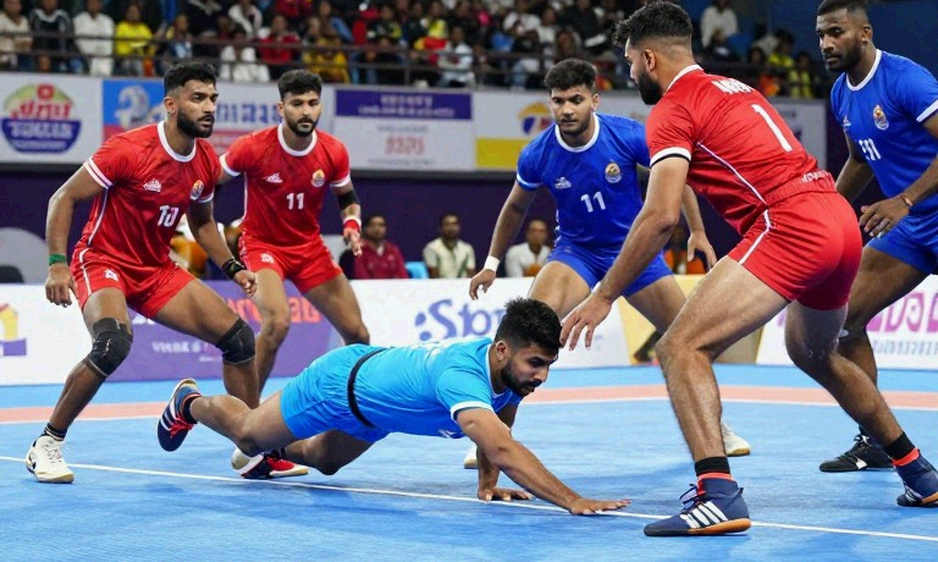
Look at Group A. Seven teams, six matches for India. On paper the sequence runs England on day one, Uganda on day two, Malaysia on three, Nigeria on four, Tanzania on five, Sri Lanka on six. India's real threat is not in the first four days but on the sixth — Sri Lanka arrives on October 29, after a single day's rest, with the fatigue of five matches already in the legs and a semifinal twenty-four hours away. Sri Lanka is the South Asian side that has occasionally unsettled India on the domestic circuit, and its advantage is not technique but timing. Compared with Malaysia and England, Sri Lanka carries the longest institutional experience of playing Indian teams.
Underrating England is the easiest mistake available and the most expensive. In a Commonwealth frame, England, Scotland, Canada and Australia are diaspora-heavy, and a large share of that pool comes from circle-style kabaddi — Punjab's circular format, with no 30-second raid clock and none of the do-or-die compulsion that binds the mat game. A good circle-style raider fights two things on the mat: the clock and the do-or-die raid. The first demands a fast decision; the second demands he accept the risk of returning empty-handed. My archive does not hold a reliable do-or-die conversion figure for circle-style recruits, so I will not invent one — but if England returns empty on two raids inside the first ten minutes against India, that will be a habit of the clock, not a deficiency of skill.
Group B interests me more than Group A, because nobody in it is carrying the host's weight. Bangladesh, Kenya, Canada, Australia, Scotland, Singapore — six teams, 15 matches, two semifinal places. The East African cluster of Kenya and Uganda is the discovery of this tournament for me. In these countries kabaddi has not yet completed the journey from field to mat, and if Kenya pushes a single match into the 35-30 range in Ahmedabad, that will be a bigger story for the organisers than any Indian gold. Since 2026 I have held that the real measure of kabaddi's growth is not India's medal count but the tackle-point totals of non-Indian teams.
Here I have to concede the limit of my own method. I hold 212 complete matches in the archive — the 2026, 2026 and 2026 World Cups, Asian Games from 2026 to 2026, and 6,400 tagged clips. How many full matches in that archive involve Kenya, Uganda, Tanzania, Nigeria, Scotland, Canada or Australia? Very close to zero. Forecasting a tournament where seven of the 13 nations have no raid-by-raid record on my shelf is not data, it is habit. So my real scorecard for this championship is not the medal table — it is how many of the 62 matches AKFI publishes raid-level data for after October 31. If not even the scorecards surface, nine days will leave us with photographs and no lessons.
Turn to the squad. Fourteen names exist; the release gives seven names and two roles, captain and vice-captain. I will not fill the remaining seven by guesswork, because misprinting a player's name is worse than misprinting a tackle count. From what is named, a raiding unit is visible: Naveen Kumar, Sachin Tanwar, Pankaj Mohite and Bharat Hooda — four raiders among whom rotation is possible. That is necessary for a five-matches-five-days schedule. The do-or-die raid is the most expensive decision in Indian kabaddi, and in my Season 5 tagging Patna converted 61 percent of do-or-die raids against a league average of 44; most of that gap lived in one raider's legs. Naveen Kumar carries that kind of load — he was the lead raider for the Dabang Delhi side that won Season 7 and Season 8. Making him vice-captain is not only an honour; it is a load-sharing arrangement.
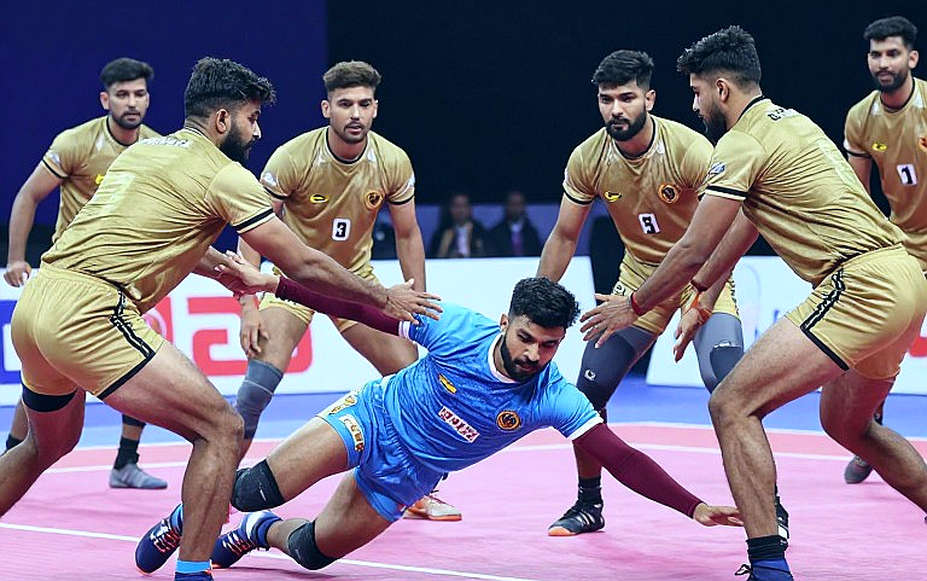
On defence the named men are Parvesh Bhainswal and Shubham Shinde, and one technical point belongs here. If India needs its left cover on the mat for more than 60 seconds a match across six games, his ankle-hold success rate will fall by the semifinal. That is not a forecast, it is the arithmetic of fatigue. A defender's error does not show on the mat; it shows only in the score. I still keep the Jakarta 2026 group match in which India lost 23-24 to South Korea and then 18-27 to Iran in the semifinal. I read that file through tackle counts and concluded the defeat was a story of selection, not talent — a reputation-picked defence against Iran's wrestling-built strength. Speed was the story in Russia until Jakarta rewrote the ending. The translation is direct: India's semifinal in Ahmedabad will not be easier than its group games. It will be harder.
Now the section I expect the most argument about — the women's event. Ten teams, 23 matches, two groups. India's Group A is Malaysia, Singapore, Uganda and Nigeria. That is four group games, all on consecutive days — October 23, 24, 25 and 26 — then nothing on the 27th, 28th and 29th, and a semifinal on the 30th. The men get five matches in five days; the women get four in four and then a three-day stall. That may be a scheduling coincidence, but it is a bad one for the team with the least preparation time: four games in four days followed by three days off is as dangerous to rhythm as playing continuously.
The women's record keeps taking me to the same turn. India has four Asian Games golds in women's kabaddi — 2026, 2026, 2026 and 2026, the last of them against Chinese Taipei in a final that stayed open to the last minute. Measured against the men, that is not a weaker record. And there is still no franchise league for women's kabaddi in India. Where the cameras go is answered every July, and the answer never changes. Coverage money and achievement are pointing in opposite directions — and the gap will show in this championship too, because the release does not say how many of the women's 23 matches get a prime-time slot. If both finals on October 31 share a single television window, you will have your answer.
One more thing I am noting: the teams India has actually lost to since 2026 are absent. No Iran, no South Korea, no Chinese Taipei, no Thailand, no Japan — none of them are Commonwealth members, so this absence is structural rather than political. The implication is plain. If India wins gold on October 31, that gold will not tell us how India handles Iran or Korea. It is not a certificate, it is a baseline — it measures the gap India holds over the 12 teams below its level. Measuring that gap is useful; the only error would be calling it by another name.

And here is my reversal, because agreement is comfortable and comfort is where mistakes live. The press-box consensus will run like this: Ahmedabad hosts the 2030 Commonwealth Games, therefore kabaddi's entry into the Commonwealth programme through this tournament is settled. I will not argue the opposite — I will only say that a host city's ambition is not a guarantee of sport inclusion. A host submits a wishlist; approvals are built elsewhere; and the usual threshold for a place on a mega-event programme is global participation. Thirteen countries is a start, not 56. If that number has not reached 25 or 30 by 2030, the conversation will not leave the meeting room. I also think the most valuable thing this tournament produces is the data, not the medals — if a first raid-level logsheet from 62 matches across 13 nations becomes public, the next generation of selection disputes will be fought on numbers rather than names.
My contrarian habit carries a risk, and I will name it so readers can hold me to it. This entire argument assumes India's group is soft and the real examination is Sri Lanka and the semifinal. If India loses a single match to England or Uganda on October 23 or 24, the reading dies that evening — I will not rescue it by calling the defeat schedule fatigue. That is my reversal threshold: one loss, and the soft-draw frame is discarded. Equally, if India's four raiders do not get comparable workloads across five days and one man absorbs 60 percent of the raids, the rotation argument fails and I will have to concede the team management chose habit over fatigue management.
The archive was always there, the pause was the point. In 2026, with the sport stopped, I logged 212 matches over five months, and that is where the habit came from: no opinion on a match before watching it end to end. The same rule applies here, which is why the 11 AM Kenya-Singapore fixture is the one I most want on record. The India-England score will appear in three newspapers; the Kenya-Singapore score will appear nowhere, and it will tell us where this tournament is actually heading.
By the evening of October 31, when both finals are done, the question will not be who scored how many points. It will be where the 62-match scorecard is in the first week of November, how many of the women's 23 matches reached television, and how many nations are coming back this time next year. Three hundred sixty-nine points, and I still rewatched the tape twice — that is the habit I want from Ahmedabad as well, because the medals will be distributed and what survives will be the data.