
First Commonwealth Kabaddi Championship in Ahmedabad: A Test for a Place at CWG 2030
अहमदाबाद में 23 अक्टूबर 2026 से पहली राष्ट्रमंडल कबड्डी चैम्पियनशिप शुरू हो रही है। नौ दिनों में 13 देशों के 400+ खिलाड़ी 62 मैच खेलेंगे, जिनमें 39 पुरुष और 23 महिला मुकाबले हैं। आयोजन AKFI कर रहा है और IKF ने मंजूरी दी है। सेमीफाइनल 30 अक्टूबर और फाइनल 31 अक्टूबर को हैं। मकसद कबड्डी को 2030 राष्ट्रमंडल खेलों में शामिल कराना है। नियमों का प्रारूप स्टैंडर्ड स्टाइल माना जा रहा है। 39 पुरुष मैचों का गणित 13 टीमों और 23 महिला मैचों का गणित करीब 10 टीमों से मेल खाता है, यानी करीब तीन देश महिला टीम नहीं भेज रहे। 400+ खिलाड़ियों का आंकड़ा मैच-गणित से असंगत है। पुरुष कप्तान सुरजीत सिंह, उपकप्तान नवीन कुमार; महिला कप्तान निधि शर्मा, उपकप्तान रितु हैं।
Ahmedabad: The inaugural Commonwealth Kabaddi Championship begins in Ahmedabad on 23 October 2026. The nine-day event will feature more than 400 players from 13 countries. A total of 62 matches will be played, including 39 men's and 23 women's games. The Amateur Kabaddi Federation of India (AKFI) is hosting the event, and the International Kabaddi Federation (IKF) has approved it. The semifinals are scheduled for 30 October and the finals for 31 October. The organisers' agenda is clear: to push for kabaddi's inclusion in the 2030 Commonwealth Games programme. In that sense, this championship is not just a tournament but an evidence file to be placed before the international Olympic and Commonwealth sports movement.
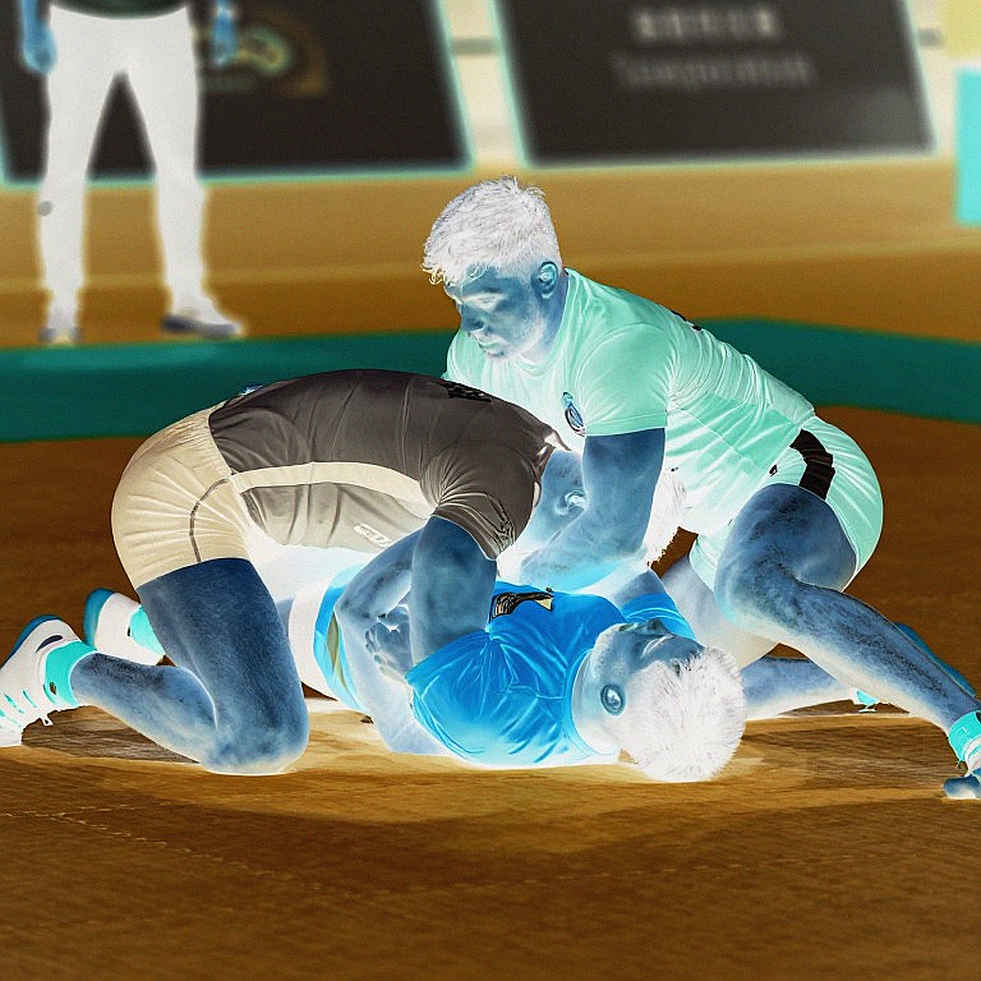
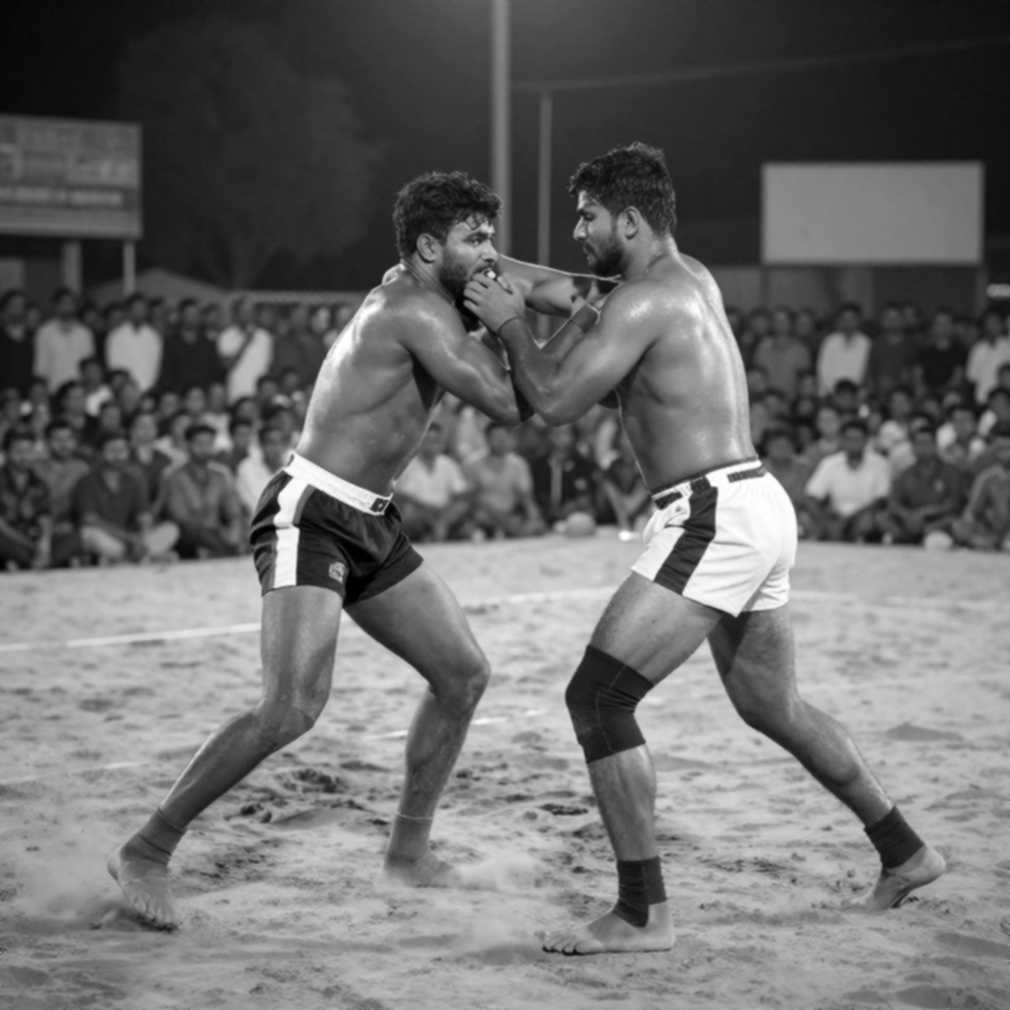
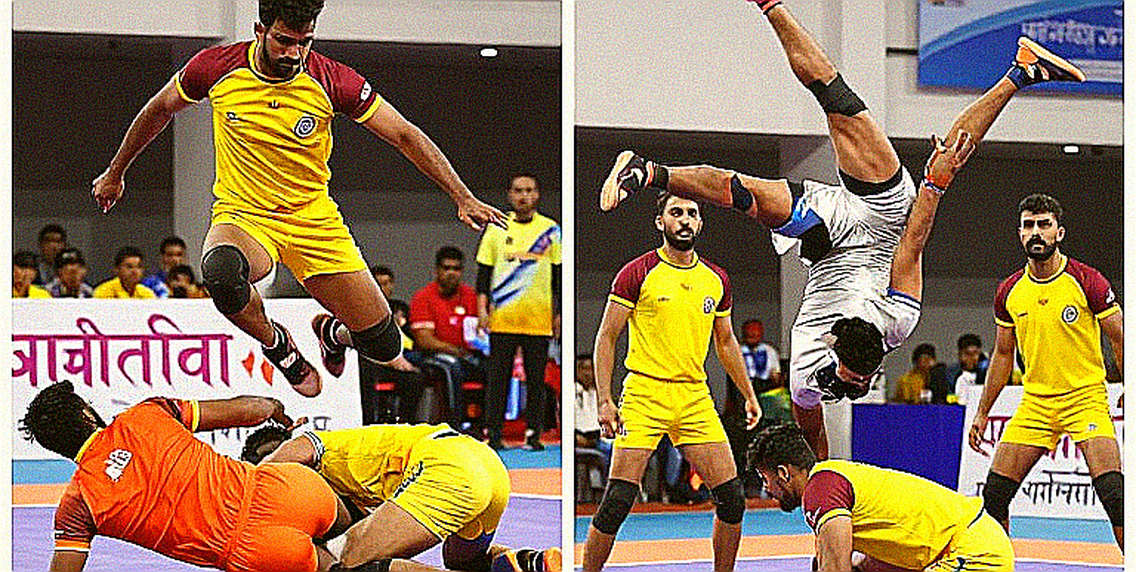
For readers with zero knowledge, kabaddi is a 7-vs-7 contact sport played on a 13m × 10m court. One player at a time attacks the opponent's half. This attacker is called the raider. The raider has 30 seconds to touch one or more defenders and must return safely to his own half. A touch scores only after a safe return. During the raid, the raider must continuously chant 'kabaddi, kabaddi...' This is called the cant. It proves the raider is not inhaling. If the cant breaks, the raider is ruled out. The defending side collectively stops the raider inside its own half, blocks him or forces him out of bounds. This is called a tackle, and it earns the defending side a point. A bonus line runs deep in the opponent's half. Crossing it earns one point, but only when the defending side has six or more players on court. When every player on one side is ruled out, it is called an all out. The opponent then earns two bonus points and the entire team returns to the court. This is the main driver of kabaddi's rapid scoring swings. After two consecutive empty raids, the third raid becomes compulsory. This is called a do-or-die raid. If the third raid also scores nothing, the raider himself is out. The rule was popularised by PKL and later adopted internationally. It forces conservative teams to take risks. A tackle made with three or fewer defenders is a super tackle and is worth two points. A single raid scoring three or more points is a super raid.
The tournament's rule architecture is linked to the International Kabaddi Federation's standard format. The source article does not name the rule variant, but given IKF approval and the international setting, Standard Style, played on a rectangular court, is the more likely variant. Circle Style, popular in rural Punjab, is less likely, because IKF institutional approval would be hard to explain otherwise. Still, from the available text alone, Circle Style cannot be completely excluded. That is a risk flag. A second risk is that the report does not mention the latest IKF rule cycle, including the scope of video review, the number of substitutions and other technical revisions.
The match arithmetic says a lot about the event's competitive depth. The 39 men's matches could mean 13 teams split into groups of seven and six. That gives 21 plus 15 group games, or 36, and three knockout matches make 39. The 23 women's matches fit exactly with 10 teams split 5 and 5: 10 plus 10 group games, and three knockouts make 23. The direct inference is that roughly three countries are not entering women's teams. This is a concrete, quantified signal about the depth and competitiveness of the women's draw. However, the group compositions are not public, so this inference should be treated with medium confidence.
The figure of more than 400 players also does not appear internally consistent. For 13 countries, 400-plus implies an average of about 31 players per country. That is possible only if all 13 countries are entering both men's and women's teams. But the 23 women's matches suggest that only about 10 women's teams are taking part. Therefore, the 400-plus figure is either approximate, includes support staff and officials, or reflects inconsistent numbers given by organisers in different places. The figure is not verifiable and should be treated as promotional.
Sixty-two matches in nine days means an average of about seven matches per day. Such density is possible only with multi-court operations. Most teams are amateur and do not have full-time sports-science support. That raises the risk of soft-tissue injuries. The event is also a test of player workload management.
The men's captain is Surjeet Singh and the vice-captain is Naveen Kumar. The women's captain is Nidhi Sharma and the vice-captain is Ritu. The available information does not make the captains' roles clear. Surjeet Singh is a common name in Indian kabaddi, and more than one player is known by it. Identity verification is therefore necessary before any tactical inference. If Naveen Kumar is the Dabang Delhi marquee raider known as 'Naveen Express', his presence would signal that India is fielding a genuinely competitive PKL-calibre squad rather than a purely developmental one. That is an important signal, but the name match is unverified. The women's vice-captain 'Ritu' is likely a shortened form of a longer registered name, such as Ritu Negi. Abbreviated naming is common in Indian sports reporting and creates attribution ambiguity.
Tactically, the only meaningful signal available is the leadership structure. Appointing a raider as men's vice-captain is consistent with a squad built around raiding output. That is India's standard template against weaker tackling units. However, no performance data such as raid points, tackle points, successful raid percentage or super raid counts are available. Claims about squad strength in media coverage should therefore be treated as promotional, not analytical.
Before the event, jerseys, captains, the anthem, the logo and the mascot were unveiled. This shows that the event's centre of gravity is brand-building rather than competition. That is not inherently bad, but it indicates that the tournament's public face is first about market and politics, and only then about sport.
The rule impact also matters. The IKF-sanctioned Standard Style is the same family used in PKL and the Asian Games. The Indian team needs no adaptation. That is an implicit competitive advantage that can widen the gap against diaspora and development teams. India's raiders are likely to exploit the bonus line heavily against deep, passive defences. Low-risk accumulation of one point at a time is exactly how strong raiding sides break down weak tackling units. It inflates margins without requiring high-difficulty touches. The do-or-die rule limits the ability of weaker teams to stall by burning empty raids. That is competitively fair, but commercially problematic for a showcase event because it compresses the possibility of upsets.
India's strategy will likely feature rotation and workload management in the group stage. The real selection test will come in the semifinals. This inference carries medium confidence because the captains' roles and fitness data are not public.
The event's biggest political-sporting message is the separate men's and women's competitions. A credible women's discipline is a hard criterion for inclusion in the Olympic programme. By building a women's draw, the organisers are trying to show that kabaddi is organised and competitive in both genders. This is not decorative signalling but institutional strategy. However, the women's draw is thinner than the men's. About 10 women's teams suggest that several countries do not have women's sides. For CWG 2030, that is a weakness, because showing India's dominance alone will not be enough. The host must demonstrate both competitive balance and depth in the women's field.
The risk list is clear. First, the rule variant is not named, so Circle Style cannot be ruled out from the text alone. Second, the latest IKF rule revisions are not mentioned. Third, the participation figures are inconsistent with the match arithmetic. Fourth, no team performance data is given. Fifth, the captains' identities and roles are ambiguous.
The conclusion is that the Ahmedabad championship is a test of kabaddi's international expansion. The rule architecture is standard, so technical friction is low. But that very standardisation may widen rather than narrow the gap between India and the rest. If India wins by a large margin, the question will arise whether this is competition or exhibition. For CWG 2030, the organisers must present verified data on women's depth, competitive balance and global participation. Only then will the tournament become a strong evidence file.
संबंधित खिलाड़ी
अनुशंसित
Ahmedabad's First Evening: Where the Points Table Ranked Teams That Had Not Yet Stepped on the Mat2026-10-28
Kabaddi's Most Expensive Player Is a Raider, Not Its Most Important2026-10-26
India vs Uganda, Match 9 Preview: The 26 Points Hidden Inside a 20-Point Win2026-10-25
The Fixture List Is the First Scout Report Nobody Reads: The Real Ledger of the Pro Kabaddi League Regular Season2026-10-25
India vs Uganda, Commonwealth Kabaddi Championship 2026: The Defensive Crack Hidden Inside a 46-26 Win2026-10-26
Seven Days, Six Matches in Ahmedabad: The Real Question at the Commonwealth Kabaddi Championship Is the Fixture List, Not the Scoreboard2026-10-27
Commonwealth Kabaddi Championship 2026: 13 Nations, Nine Days in Ahmedabad — and an Empty Heading That Explains the Whole Tournament2026-10-24
अनुशंसित
Ahmedabad's First Evening: Where the Points Table Ranked Teams That Had Not Yet Stepped on the Mat2026-10-28
Commonwealth Kabaddi Championship 2026: 13 Nations, Nine Days in Ahmedabad — and an Empty Heading That Explains the Whole Tournament2026-10-24
India vs Uganda: At the Commonwealth Kabaddi Championship 2026, the Real Question Isn't the Match — It's the Field2026-10-25
India vs Uganda, Commonwealth Kabaddi Championship 2026: The Defensive Crack Hidden Inside a 46-26 Win2026-10-26
Whose Clock Is It? From Jakarta's 18-27 to the Ledger Kabaddi Has Never Published2026-10-26
Commonwealth Kabaddi Championship 2026, Day 1: The Arithmetic of the Points Table, Lovepreet Brar's 23 Points, and the Incomplete Sample of Internationalisation2026-10-25
First Commonwealth Kabaddi Championship in Ahmedabad: A Test for a Place at CWG 20302026-10-28