
From the Mat to the Mainstream: Kabaddi's Professional Turn and the Road Ahead
कबड्डी भारत का पारंपरिक संपर्क खेल है जो पिछले एक दशक में प्रो कबड्डी लीग के ज़रिए पेशेवर खेल के रूप में बदल गया है। इसका आधार अब केवल शारीरिक ताकत नहीं, बल्कि वीडियो विश्लेषण, आँकड़े और रणनीतिक कोचिंग है। भारतीय पुरुष और महिला टीमें एशियाई खेलों में प्रमुख रही हैं, जबकि ईरान सबसे संगठित अंतरराष्ट्रीय प्रतिद्वंद्वी है। खेल की मुख्य चुनौतियाँ हैं — एक ही लीग पर आर्थिक निर्भरता, व्यस्त कैलेंडर, प्रशासनिक अस्थिरता, महिला कबड्डी के लिए सीमित व्यावसायिक अवसर और ग्रासरूट विकास पथ की असमानता। ओलंपिक में शामिल होने के लिए वैश्विक भागीदारी का दायरा बढ़ाना ज़रूरी है, लेकिन अल्पकाल में पारदर्शी शासन, मज़बूत जूनियर कैलेंडर और बुनियादी ढांचे पर ध्यान देना अधिक व्यावहारिक है।
Kabaddi is often described as a village game and then quietly set aside. That description is half true and half unjust. It is true that kabaddi was born on open ground and that its greatest strength is its simplicity: no ball, no bat, no expensive equipment — only breath, body and nerve. The injustice is that this simplicity was long mistaken for smallness. The most important change of the past decade is that kabaddi is no longer purely a contest of strength. It has become a contest of strategy, data, video analysis and professional management. Every player who steps onto the mat knows that every move is watched by cameras, coaches and analysts.
This is not the story of a single match or tournament. It is the story of the system that turned kabaddi from a fairground spectacle into a broadcast product — and of that system's unresolved weaknesses. The Olympic question, the expansion of women's kabaddi, administrative instability and the neglect of the grassroots are the four threads currently weaving the sport's future together.
The league gave the sport a new structure
The professionalising impact of the Pro Kabaddi League was structural rather than technical. Earlier a player depended on a departmental job, a state unit or a patron. The league created a market in which skill had a direct price. Auctions, franchises, coaching staff, physios, trainers and media teams arrived together. The effect reached beyond top players: when a boy from a district appears on television with a multi-crore contract, kabaddi becomes a career rather than an alternative to study. The league also redrew the sport's geography, bringing Haryana, Uttar Pradesh, Maharashtra, Tamil Nadu, Telangana and the north-east onto one platform — widening talent identification while also deciding which academies would thrive and which would be left behind.
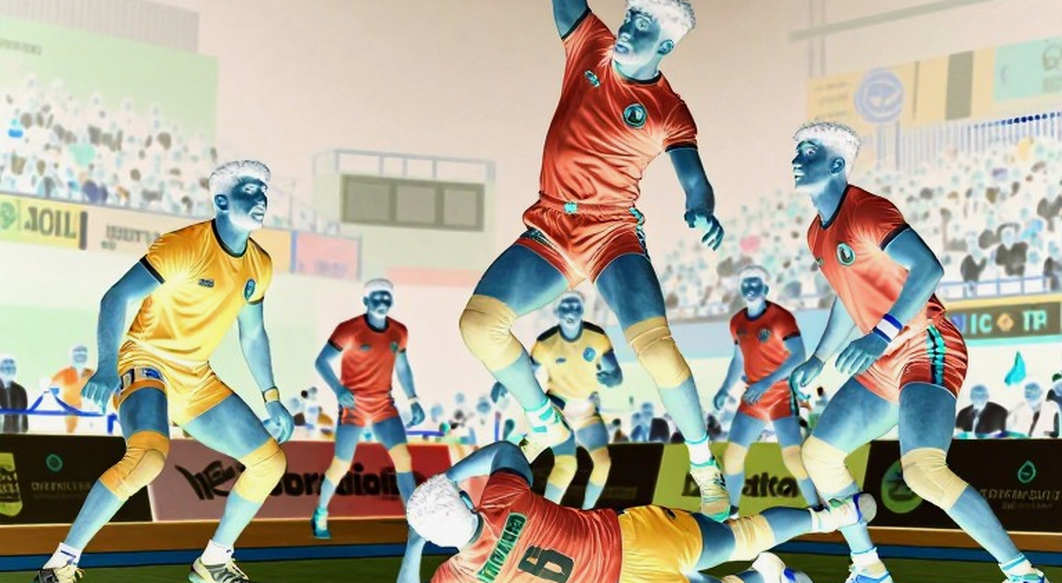
But the league is not an unmixed blessing. A condensed window, changing franchise ownership and the foreign-player quota all deserve more scrutiny than they receive. The sharpest problem is calendar conflict: commercial commitments and national camp preparation collide, and the player is caught in between. No durable solution has yet been found.
The science of raiding
In older kabaddi the raider's task was simple — survive as long as possible. In the modern game a raid is a planned event. The raider knows which cover is opposite, that defender's favoured tackle, when he dips onto his left leg, when he rushes. Technique has broadened: pressure with a clasped hand is no longer the only weapon. Dubki, skip, crossover and body movement designed to unbalance a defender, followed by a swift turn, are woven into a single raid. The best raiders do not avoid tackles; they invite them and turn the invitation into a trap.
There is an interesting paradox here. As raiding became more mathematical, instinct did not lose value. The decision taken on the mat — when to stop, when to lunge, when to spend a whole breath and achieve nothing — is not made by data but by the body. The finest raiders possess both: the discipline of preparation and the nerve to decide in an instant.
Defence: the mathematics and psychology of the tackle
The great misconception about kabaddi is that defence is passive. The opposite is true. A good defence controls the game. Cover position, corner angle and tackle timing together shrink the raider's options. When one corner is aggressive and the other restrained, the raider must recalculate every time. That is the real pressure.
Defence is also psychological. A team that is behind tackles in a hurry, and hurried tackles miss. Modern coaching therefore emphasises waiting as much as striking. Patience has become a technique. Many matches are decided by which team's cover can stand error-free for thirty seconds. Defender identity has shifted too: once it was defined by how hard a player held, now by whether he knows when to hold and when to hold back. That is why experienced defenders remain relevant even as their speed declines.
Data, video and the analysis apparatus
A professional sport changes when performance becomes measurable. Kabaddi began this process late but has moved fast. Raids per minute, tackle success percentage, decision quality in do-or-die situations, scoring ability on the third attack — these are now standard vocabulary. Analysts break down opponents' habits: which corner becomes more aggressive in the second half, which raider grows careless after three successful raids.
Data carries a risk too. What is visible gets measured, and what is measured gets overvalued. A raider's true utility often lies in the phase when he is not scoring — when he draws the defence to create space for another raider. There is no column for that contribution. The gap between real analysis and imitation analysis lies exactly here. Yet analysis has democratised coaching: intuition once belonged to a few veterans; now a small staff with video and statistics can prepare competitively, provided it has a clear thinker rather than a spreadsheet filler.
The quiet change in coaching culture
Kabaddi coaching was traditionally discipline-centred; it is now management-centred. A modern coach does not merely run drills; he manages workload, judges recovery timelines and decides who rests in which match. This shift is visible across Indian sport, but it is more dramatic in kabaddi because physical contact is so high. A gap persists: India has no standardised route to becoming a kabaddi coach. Many coaches are former players with invaluable experience but no formal sports-science training, while trained professionals often lack fine-grained knowledge of the game. The ideal is a blend, and some franchises have adopted it — a head coach for strategy, support staff for the body. The direction is right; institutionalising it is pending.
Rural India: rough ground, solid talent
Kabaddi's real factory remains the village and the small town. In the empty grounds of rural Haryana, Uttar Pradesh and Maharashtra, the evening game is the first filter. There is no coach, no camera, no data — only competition, and competition is the sternest teacher. The problem begins afterwards. Once talent is spotted, the development pathway is uneven. A child in a district with a good hall and an experienced coach advances quickly; elsewhere he stalls, or — more painfully — learns faulty technique that takes years to correct. The league cannot fix this. State units and public schemes must.
The economics of scouting and the auction
The auction is kabaddi's most interesting institution because it seats sport and market at the same table. A player's real value and his bid price need not match. A limited-role specialist can go expensive; a complete player can go cheap. The difference is scouting quality. Good scouting is not spotting the brightest talent; it is understanding which piece the team lacks and filling it affordably. This skill is professionalising, but many decisions still rest on old relationships and familiar names. Better data will replace sentiment with reasoning — and that ultimately serves players, because reasoned evaluation is less biased.
The international picture: Iran and rising competition
India is the strongest kabaddi nation, but it is a mistake to assume the sport is one-sided. Iran has emerged as the most organised rival, built on disciplined defensive structure and patience in the raid. Iranian teams take fewer risks and force opponents into error; that approach has worked against India more than once, and the lasting lesson is that discipline outlasts power. Bangladesh, South Korea, Chinese Taipei and Thailand have invested at their own levels. The real international constraint is that most nations have no domestic league. Without domestic competition players do not develop; without players the international standard stays weak. Breaking that cycle is the key to global expansion.
Asian Games, the Olympics and the politics of recognition
Kabaddi is a permanent part of the Asian Games and India's record there has been near-total, with one exception when Iran took the men's gold. That defeat was a gift: it proved the monopoly could crack. India returned and reclaimed gold. The episode shows how an absence of competition dulls a sport from within. An Olympic place is a recurring question that cannot be settled by enthusiasm alone. Olympic inclusion demands a defined global footprint — organised structures across a certain number of continents and countries. Kabaddi remains short of that, even though its Asian expansion is solid. Seeking the Olympics is fair; treating it as the only goal is not. Strengthening the domestic structure, the junior calendar and women's competitions is more practical in the meantime.
The national team: camps, selection and calendar
Running a national camp looks easy and is not. Players arrive from different franchises with different preparation methods — some trained for aggressive raiding, some for patience. A camp must teach them a shared language. Selection has also drawn questions. When the basis is not transparent data and match situations, controversy is inevitable. What is needed is an evaluation framework that weighs performance under pressure, not only raw scores.
Women's kabaddi: pace ahead, structure behind
The Indian women's team's record is excellent, especially its successive Asian Games golds. Technically and physically the women's game lags in nothing. Yet commercial opportunity is clearly unequal. The ecosystem built by the men's league did not reach women players on equal terms. Two consequences follow: many talented players cannot plan a long career because the financial future is unstable, and at the grassroots parents still rank sport second for daughters. Both are being addressed — expanded national competition, broadcast, dedicated state schemes — but the point has not been reached where a girl can say kabaddi is a fully secure career.
Governance: the biggest bottleneck
Technical progress cannot overcome administrative failure. Indian kabaddi's deepest problem has been domestic governance: prolonged disputes within the national federation, electoral deadlock and administrative uncertainty. The cost falls directly on players — dates change, selections stall, international participation is questioned. The direction of reform is clear even if the route is hard: a stable election process, financial transparency and independent evaluation. This sounds bureaucratic, but its effect reaches the mat. Stability is not a luxury; it is basic infrastructure.
Media, broadcast and a growing fan culture
Kabaddi's recent advantage is that it is genuinely watchable: fast, visibly physical and simple to score. League broadcast took the sport into homes, and commentary in regional languages kept it rooted. Fan culture, however, remains largely confined to two cities and one league. National championships and federation events get little space. That imbalance is damaging: the more channels through which a fan watches, the deeper the attachment. The real task is converting a league fan into a sport fan.
Injury, fitness and player welfare
Kabaddi is among India's most collision-heavy sports. Knees, ankles, shoulders and lower back absorb a load no less than in any contact sport, yet the welfare structure is uneven. The league provides physios and sports science; state-level infrastructure often does not. The most serious issue is career length. How many years can a collision athlete last? The answer still rests largely on guesswork. Workload management, rehabilitation and mental health all need formal attention — a humanitarian duty and an economic argument, since a trained player cannot be replaced overnight.
Junior and development pathways
A sport's stability lives in its junior structure. Kabaddi has junior competitions, but both calendar and visibility are limited. A junior cannot see a clear route from under-16 to senior — where to play, which selection process to enter, which performance opens which door. That ambiguity scatters talent. The ideal is a ladder in which school sport, state championships and national junior competition connect in one logical order. Some states have this; most do not — which explains why some states keep producing players while others lag despite opportunity.
Infrastructure and equipment
Kabaddi's fortune is that it needs no expensive architecture: a mat, a hall and basic safety, and the game can begin. That is its great social strength. At professional level the same simplicity becomes a limit. International-standard mats, adequate ventilation and medical facilities exist in only a handful of cities. The effect on competition is direct: a player training on a mat is ahead of one training on earth — not only technically but in the safety of ankles and knees. Infrastructure is therefore a fairness issue, not merely a convenience.
Challenges: calendar, finance and league dependence
Kabaddi's biggest structural weakness is that its economic centre is a single league. If a season is disrupted, the whole sport's visibility — and players' incomes — suffer. Reducing that risk requires independent domestic competitions, state-level leagues and decentralised corporate sponsorship. The second challenge is the calendar: balancing national camps, league, international events and rest. Player fatigue is not abstract; it shows up directly in injury and performance. A shared annual calendar with all stakeholders is a priority. The third is unequal visibility — men and women, league and non-league, city and village. Closing these gaps will require policy, not markets.
The road ahead
Kabaddi is in the rare position of having achieved popularity while its structure is still being built. That is both opportunity and risk. If, over the next few years, three things happen — transparent and stable governance, a genuine professional platform for women's kabaddi, and a clear pathway from grassroots to senior level — the sport can change its identity within a decade. If they do not, the league will continue, a few stars will be made and a few left anonymous. The sport will hold its place but will not reach its capacity. Kabaddi's finest quality is that it leaves little room for pretence. On the mat, the space to breathe is small and the penalty for error is immediate. That simplicity is what makes it great. One thing now remains: that the same simplicity return to the system that runs the sport off the mat. When administration becomes as clear and disciplined as a corner defender, kabaddi will need no further validation.